4.7 Change of Basis: Class Notes
Coordinate Maps
Note: Recall that is the coordinate vector for a vector relative to a basis . When considered as a column vector, this author uses the notation .
Definition
If is a basis for a finite-dimensional vector space , and if is the coordinate vector of relative to , then the mapping is the coordinate map relative to from to .
The standard basis for is
Relative to this basis, the coordinate vector for is . But as we saw in 4.5, the coordinate vector relative to
is . The coefficients change because the basis is different.
This produces a mapping from into :
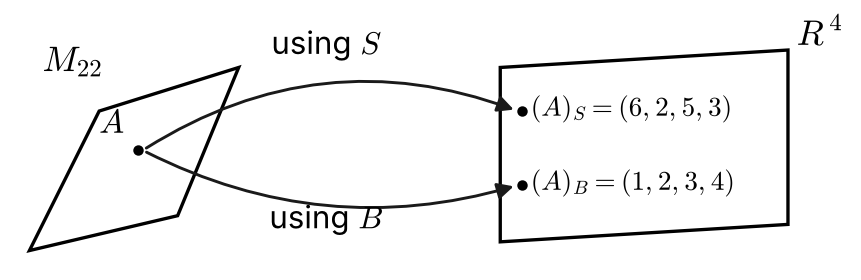
The matrix in is sent to two different points of : using it goes to , and using it goes to .
The goal of this section is to provide a link between and , or more generally, between and .
Transition Matrices
To transition from one basis to another basis for the same vector space, we use a transition matrix, denoted by .
In 4.5, we found for with respect to the basis , where , , and by row reducing an augmented matrix. Here we achieve the same result by using a transition matrix from , the standard basis for , to .
In what follows, will take the place of , and will take the place of , to match the definition below.
To find a relationship between and , we start by finding a linear combination of vectors in that map to vectors in :
This is 3 systems that we can solve simultaneously. The columns on the left are the vectors in , and the columns on the right are the vectors in :
The three columns on the right give the combinations of the vectors in that produce , , and , in that order.
The resulting matrix on the right maps a vector relative to to a vector relative to .
Consider . This is . Now:
These are the coordinates of relative to . That is,
Thus,
Definition
If we change the basis for a vector space from an old basis to a new basis , then are the coordinate vectors for the old basis vectors relative to the new basis. The transition matrix from to is the matrix having these vectors as its columns and is written [by this author] as . Note that this is a partitioned matrix.
We use this as follows: For every vector in ,
#3
Consider the bases and for , where
a. Find the transition matrix to .
b. Compute the coordinate vector , where and use the transition matrix in part (a) to compute .
c. Check your work by computing directly.
Solution
a. Put the new basis vectors on the left and the old basis vectors on the right, and row reduce until the identity is on the left; what remains on the right is :
Answer:
b.
Answer:
c.
Answer: , which matches part (b).
Why the Transition Matrix Works
This process is generalized in the case thus: Let be called the old basis and be a new basis.
First, find the coordinates that map to . That is, when applied to vectors in , they return vectors in . In the case:
Now let be a fixed vector in (for which and are bases). In terms of ,
So the new coordinate vector for relative to is
The first column is , and the second column is . This matrix transitions from to !
Theorem 4.7.1
If is the transition matrix from a basis to a basis for a finite-dimensional vector space , then is invertible, and is the transition matrix from to .
#13
If is the transition matrix from a basis to a basis , and is the transition matrix from to a basis , what is the transition matrix from to ? What is the transition matrix from to ?
Solution
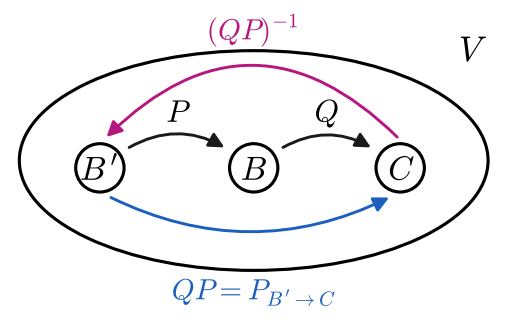
Three bases , , of . goes from to and goes from to . The combined arrow from to is . The arrow back from to is .
Going from to uses , and then going from to uses , so . Going back the other way, .
Answer: and