6.3 Gram-Schmidt Process: Class Notes
Definition
A set of two or more vectors in a real inner product space is said to be orthogonal if all pairs of distinct vectors in the set are orthogonal. An orthogonal set in which each vector has norm 1 is said to be orthonormal.
Just as with the Euclidean inner product, we can normalize a nonzero vector to obtain a unit vector:
Theorem 6.3.1
If is an orthogonal set of nonzero vectors in an inner product space, then is linearly independent.
Proof
Suppose and consider, for ,
But by the additivity and homogeneity axioms,
since for because is orthogonal. So .
Since , by the positivity axiom, so for every . Thus is linearly independent.
Definition
In an inner product space, a basis comprising orthogonal vectors is an orthogonal basis, and a basis comprising orthonormal vectors is an orthonormal basis.
Example: With the Euclidean inner product, is an orthogonal basis for . Normalizing each vector gives an orthonormal basis:
#6
Show that the column vectors of form an orthogonal basis for the column space of with respect to the Euclidean inner product, and then find an orthonormal basis for that column space.
Solution
Call the columns , , and . Check each pair:
The columns are nonzero and orthogonal, so by Theorem 6.3.1 they are linearly independent. They span the column space, so they form an orthogonal basis for it.
To normalize, first scale the columns to clear the fractions (scaling by a positive number doesn’t change the unit vector):
Divide each scaled column by its norm. The orthonormal basis is
Answer:
Theorem 6.3.2
a) If is an orthogonal basis for an inner product space , and if is any vector in , then
b) If is an orthonormal basis for an inner product space , and if is any vector in , then .
So with an orthogonal basis, the coordinates of come straight from inner products, with no system to solve: the boxed coefficients in (a) are the entries of the coordinate vector.
Proof
Let be in . Since is a basis for , there are scalars with . For ,
because is orthogonal (every other term is 0, as in the proof of Theorem 6.3.1). Hence
If is an orthonormal basis, then , so . This is part (b).
#8
Use Theorem 6.3.2(b) to express the vector as a linear combination of the vectors , , .
Solution
First note that this is an orthonormal basis with respect to the Euclidean inner product (the dot product): , , and each vector has norm 1. So
Answer:
#12
Find the coordinate vector for the vector and the basis that were given in Exercise 8.
Solution
The coordinates are the coefficients found in #8.
Answer:
Note that since is an orthonormal basis, no augmented matrix is required.
Theorem 6.3.3 Projection Theorem (generalization of Theorem 3.3.2)
If is a finite-dimensional subspace of an inner product space , then every vector in can be expressed in exactly one way as where is in and is in .
Definition
If is a finite-dimensional subspace of an inner product space and a vector in is expressed as , where is in and is in , then is called the orthogonal projection of on and is denoted by and is called the orthogonal projection of on and is denoted by . The vector is also called the component of orthogonal to .
Theorem 6.3.4
Let be a finite-dimensional subspace of an inner product space .
a) If is an orthogonal basis for and is any vector in , then
b) If is an orthonormal basis for and is any vector in , then
Here is -dimensional and is -dimensional. The basis vectors lie in (a basis for would continue on to ), and is any vector in , not necessarily in .
Proof
From Theorem 6.3.3, with in and in . Since is in , Theorem 6.3.2(a) applied to gives
Since is in , , so
Therefore
If the basis is orthonormal, then , which gives part (b).
#24
The vectors and are orthogonal with respect to the Euclidean inner product on . Find the orthogonal projection of on the subspace spanned by these vectors. [Extension of the exercise] Then find in such that .
Solution
By Theorem 6.3.4(a), with , , , and :
Answer:
Answer:
Check that is in :
#25
The vectors , , and are orthonormal with respect to the Euclidean inner product on . Find the orthogonal projection of onto the subspace spanned by these vectors.
, ,
Solution
The basis is orthonormal, so by Theorem 6.3.4(b),
Multiply out (for example, ):
Answer:
Theorem 6.3.5 (proof outlines the Gram-Schmidt process)
Every nonzero finite-dimensional inner product space has an orthonormal basis.
Proof
This is a constructive proof. Let be any nonzero finite-dimensional subspace of an inner product space and suppose is any basis for . We will produce an orthogonal basis for that can be normalized to form an orthonormal basis.
Let and let be the space spanned by .
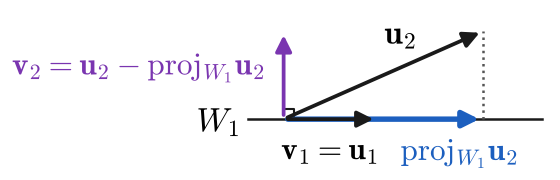
The line contains . The vector points up and to the right. Its projection lies along , and starts at the origin and is perpendicular to .
Let
We know , because if it were, would be a scalar multiple of , contradicting that is linearly independent. By construction, .
Now let be the space spanned by and .
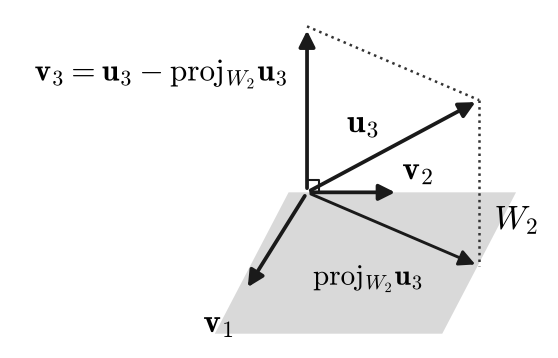
A shaded plane contains and . The vector points up out of the plane. Its projection lies in the plane, directly below the tip of , and starts at the origin and is perpendicular to the plane.
is orthogonal to , and so is orthogonal to and . We can likewise find a vector that is orthogonal to , , and :
and so on until we have vectors. Normalizing the results in an orthonormal basis.
Example
Let have the Euclidean inner product. Use the Gram-Schmidt process to transform the basis into an orthonormal basis.
, , ,
Solution
We want an orthogonal set first, then we normalize. Start with
Scaling doesn’t affect orthogonality, so use to avoid fractions.
Tip: Check for orthogonality as you go: .
Use .
Tip: Check: and .
Here and , so those terms drop out, and with :
Use .
Tip: Check: , , .
Orthogonal basis:
The norms are , , , and . Dividing each vector by its norm gives the orthonormal basis
Answer:
Theorem 6.3.6 (inner product space analog of Theorem 4.6.5 (b))
If is a finite-dimensional inner product space, then:
a) Every orthogonal set of nonzero vectors in can be enlarged to an orthogonal basis for .
b) Every orthonormal set of nonzero vectors in can be enlarged to an orthonormal basis for .
Example 6.3.9 Legendre Polynomials
Let the vector space have the inner product . Apply the Gram-Schmidt process to transform the standard basis for into an orthogonal basis .
Solution
Start with , , .
Compute the pieces:
Answer:
Suppose we want a scalar such that . Then
We then have .
Definition
The first three Legendre polynomials are , , and . They result from transforming the standard basis for with the inner product into an orthogonal basis for via the Gram-Schmidt process, scaled so they have a value of 1 at .