2.3 Linear Equations: Class Notes
2.3a
Definition
A first-order differential equation of the form is a linear equation in (the dependent variable). This is put into standard form by dividing both sides by to obtain
The function is called the input function or forcing function. A term such as would make an equation nonlinear.
Example
Consider the DE . In standard form, this is .
If we multiply both sides by , we get
Aside: differentiate with respect to . First, a second aside to recall how this works.
Second aside: implicit differentiation
Consider , where is a function of . Differentiate the first term with the product rule :
The factor comes from the chain rule, because depends on .
In the same way, by the product rule,
This is exactly the left side of the equation above, so the equation can be written as . Integrate both sides with respect to :
Answer:
is called an integrating factor.
Where did come from?
For the equation in standard form
suppose we have some function ( is the Greek letter mu) such that when we multiply both sides of by , we get
If it happens that , then the left side becomes
and by the product rule, . Then we have
To find , solve the separable equation
Answer:
Tip: A constant of integration is not necessary when finding or using an integrating factor: , and any constant multiple of an integrating factor works just as well.
2.3b
Example
Find the general solution of the given differential equation. Give the largest interval over which the general solution is defined. Determine whether there are any transient terms in the general solution.
Solution
This is a linear DE, so use an integrating factor. , so
Multiply both sides by . The left side has the form :
Integrate by parts with , , so , :
Answer:
is the steady-state solution. The term goes to as , so it is a transient term.
Interval: . Transient term: .
Example
Solution
Standard form: divide by , using :
So . Write the numerator as to split the fraction:
(Here we take , so .) Multiply by and integrate:
Integrate by parts with , , so , :
Integrate by parts again with , , so , :
Combine and divide by :
Answer:
No transient terms. The solution is defined on ; the interval of solution is .
2.3c
Example
Solution
Steps
1. Put the equation in standard form.
2. Find and use .
3. Integrate.
4. Isolate .
Standard form (divide by ):
Multiplying by turns the right side into :
Answer:
Interval of solution: . It's all transient: both terms go to as .
Example
Solution
Here the independent variable is and the dependent variable is . Move the term to the left to get standard form:
Multiply both sides by . The left side has the form :
Integrate with the substitution , so :
Answer:
Transient term: . Interval: .
Example
Solution
The equation is linear if its standard form is . Divide by :
So . To find , use partial fractions:
Setting gives . Setting gives .
(On the interval , is positive, so the absolute value can be dropped.) Multiply the standard form by :
The left side is and the right side simplifies to :
Answer:
No transient terms. Interval: .
2.3d
Example
Solve the given initial-value problem. Use a graphing utility to graph the continuous function .
Solution
(A graphing utility is a program such as Desmos or GeoGebra.) Solve the DE separately on each piece of . Standard form on each piece:
Both pieces have the same integrating factor:
For :
For :
The initial condition is at , which is in the first piece: . So
To find , use the requirement that is continuous, so is continuous at .
Recall
is continuous at if , and exists when .
At , the formula on the left and the formula on the right must give the same limit:
With , the second formula becomes :
Answer:
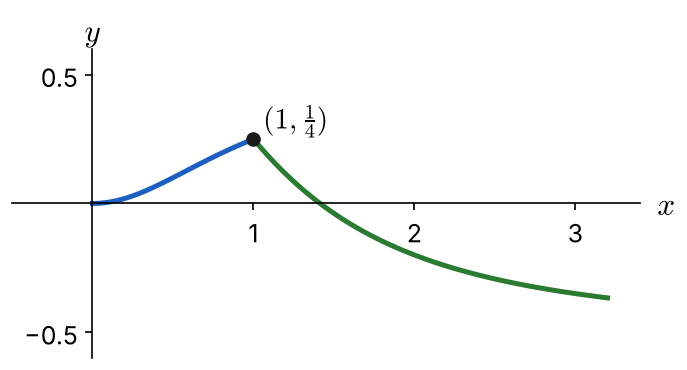
For , the graph rises from the origin to . For , it decreases from , crosses the -axis at , and levels off toward . The two pieces meet at with a corner, so is continuous but not differentiable there.