7.1 Definition of the Laplace Transform: Class Notes
7.1a
The Laplace transform is a tool for solving differential equations.
Definition
A transform transforms one function to another function.
Examples of transforms
The derivative and the integral:
and are transforms.
is a transform.
Transforms possess the linearity properties, e.g.,
A constant multiple comes out in front of the transform, and a sum is transformed term by term.
Definition 7.1.1
Let be a function defined for . Then the integral is said to be the Laplace transform of , provided that the integral converges.
The factor is part of the definition; it is always there. The function is what is being transformed.
The Laplace transform possesses the linearity properties.
Example 1
Evaluate .
Solution
For , as , so the value at the upper limit is 0. Only the lower limit contributes: .
Answer:
Example 2
Evaluate .
Solution
Integrate by parts with , so .
The first term is 0: written as , the exponential grows much faster than , so the term goes to 0 as , and it is 0 at . This holds for .
Answer:
Example
Evaluate
Solution
Using the linearity property, we have
Answer:
7.1b
Example
Evaluate
Solution
Integrate by parts with , so .
The first term is 0: as , (and stays between −1 and 1), and at , . Integrate by parts again:
Integrate by parts with , so .
At the upper limit the first term is 0; at the lower limit it is , so the first term is . The integral that remains is again:
Answer:
Theorem 7.1.1: Transforms of Some Basic Functions
- (a)
- (b) ,
- (c)
- (d)
- (e)
- (f)
- (g)
7.1c
Definition
A function is said to be of exponential order if there exist constants , and such that for all .
In words: does not grow faster than an exponential in the long run.
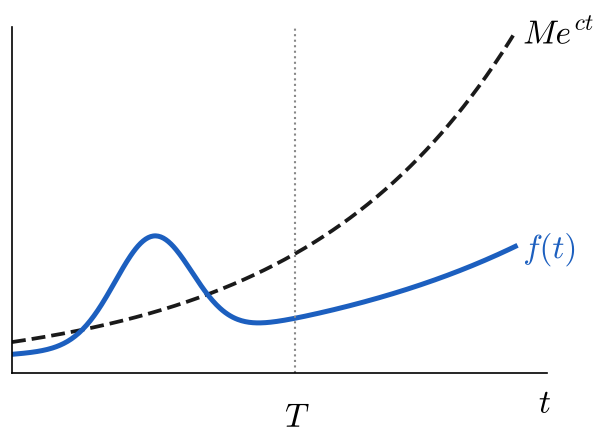
Graph of a function (drawn thicker, in blue) and the dashed exponential curve . Near the graph of has a bump that rises above the exponential, but for every the graph of stays below .
Theorem: Sufficient Conditions for Existence
If is piecewise continuous on and of exponential order, then exists for .
Proof
is of exponential order, so there are constants such that for . Split the integral at :
exists because is piecewise continuous (and the interval is finite). For , use the bound on :
which is finite if . converges and converges, so converges. ✓
“Sufficient” is a guarantee. The conditions given are not necessary conditions. That is, in some cases, is not of exponential order or not piecewise continuous, but exists.
Theorem: Behavior of F(s) as s → ∞
If is piecewise continuous on and of exponential order and , then .
Proof
is of exponential order, so there exist such that for . ( is the Greek letter gamma.)
is piecewise continuous, so is bounded on : .
Let and , so for all . Then
for . As , , so ; that is, .
7.1d
Example
Use Definition 7.1.1 to find .
Solution
Split the integral where the formula changes: on [0, 1) the function is 2t + 1, and for t ≥ 1 it is 0.
The second integral is 0. Integrate the first by parts with , , so , :
Answer:
Example
Use Definition 7.1.1 to find .
Solution
The factor is a constant, so it comes out of the integral. The value at the upper limit is 0 when , that is, .
Answer:
Example
Use Theorem 7.1.1 to find .
Solution
By linearity, then parts (b) with , (c) with , and (a):
Answer:
Solution
is not in the table, so first use the identity :
Now use parts (a) and (e) with :
Answer: