← Back to Math 055
7.4 Operational Properties II: Class Notes
7.4a
Derivatives of Transforms
The formulas we saw before and are transforms of derivatives. Now we will consider derivatives of transforms.
Consider . Differentiating with respect to yields
The derivative of with respect to is , which brings out the minus sign and the extra factor .
Example
Evaluate the given Laplace transform.
Solution
The factor means a negative derivative of the transform of :
Answer:
Solution
Now is a shift (replace by in the transform of ), and is a negative derivative:
Answer:
Two factors of . Apply the rule twice:
(Each factor of brings one derivative and one minus sign; the two minus signs cancel.)
In general, we have
Theorem 7.4.1: Derivatives of Transforms
If and , then .
Example
Use Theorem 7.4.1 to evaluate the given Laplace transform.
Solution
Here and . The first derivative (quotient rule) is :
Cancel one factor of from every term, so the denominator becomes :
Answer:
Example
Use the Laplace transform to solve the given initial-value problem. Use the table of Laplace transforms in Appendix C as needed.
Solution
The right side is the previous kind of transform, with the shift from :
Entry 25 of the table in Appendix C (with ) gives . Here s is shifted to , so multiply by :
Answer:
7.4b
Solution
Write with unit step functions, as a sum of two pieces:
The factor is not written in terms of , so use the alternative form of the second translation theorem: replace by .
Aside
Since , dividing by gives
First piece. Partial fractions:
terms: . terms: . Constant: . So .
Second piece. Partial fractions just gives the term back (with and the other constants 0), so instead use , that is, . Since
and is the transform of , so .
Use the inverse form of the second translation theorem: replace by .
Simplify with and :
Answer:
7.4c
Convolution
Definition
The convolution of and is
( is the Greek letter tau.) The result is a function of . It can be shown that .
Tip: Don’t confuse convolution with composition, , the composition of with .
Example
Find .
Solution
With and , :
Integrate by parts with , so .
Integrate by parts with , so .
The last integral is again. Solve for :
Answer:
Example
Find .
Solution
Use the convolution from the previous example:
Answer:
Notice: .
In general,
Theorem: Convolution Theorem
If and are piecewise continuous on and of exponential order, then .
Proof
Note that , so if . Multiplying by lets the inner integral run to (the extra part, , is zero):
After switching the order of integration, the inner integral is = by the second translation theorem:
Example
Find the Laplace transform of using the Convolution Theorem. Do not evaluate the convolution integral before transforming.
Solution
For , use :
Answer:
Solution
The integral is (compare with the definition ):
Answer:
7.4d
Solution
Here and , so the integral is :
Answer:
The transform of an integral
When , , the convolution theorem gives
, which in inverse form is .
That is, : dividing a transform by integrates from 0 to .
Example
Evaluate the given inverse transform.
Solution
No partial fractions are needed. Write it as times , and , so :
Integrate by parts with , , so , :
Answer:
Example
Use the Laplace transform to solve the given integral equation.
Solution
The integral is , so its transform is :
Partial fractions, with a repeated linear factor:
: . : . : , so .
Answer:
Example
Use the Laplace transform to solve the given integrodifferential equation.
Solution
The integral is , so its transform is :
7.4e
Theorem: Transform of a Periodic Function
If is piecewise continuous on , of exponential order, and periodic with period , then .
Proof
In the second integral, let , so and . The limits change: becomes , and stays . Since is periodic, :
Substitute back, and write as :
Example
Find the Laplace transform of the given periodic function.
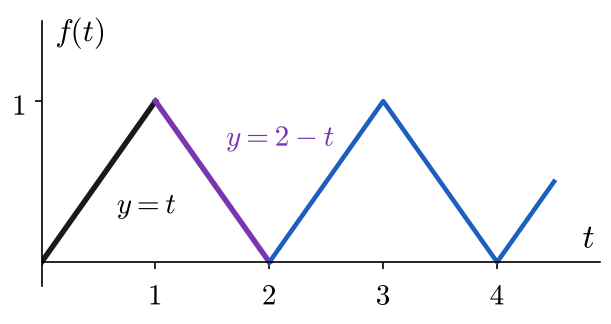
Triangular wave with period . On the first period it rises along from to , then falls along to . The same shape repeats: peaks at and zeros at .
Solution
On one period,
so is periodic with period . By the theorem,
Integrate each by parts: , for the first, and , for the second. The two integrals are
Their sum is . Factor and cancel:
Answer: