7.5 The Dirac Delta Function: Class Notes
7.5a
Consider a function that represents a short burst of constant energy. Start with two unit step functions, with :
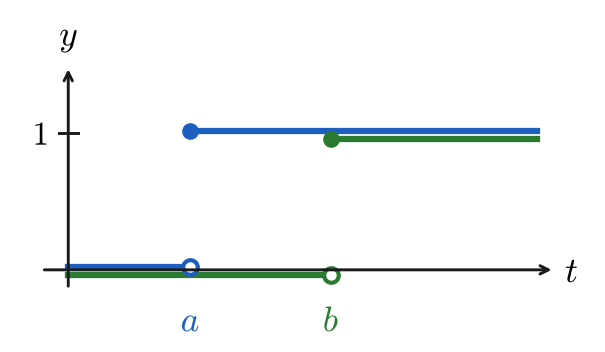
Two unit step functions on the same axes. is 0 for and jumps to 1 at . is 0 for and jumps to 1 at .
Subtracting them turns the function on at and off again at :
Now center a pulse like this at , give it width , and give it height , so that its area is :
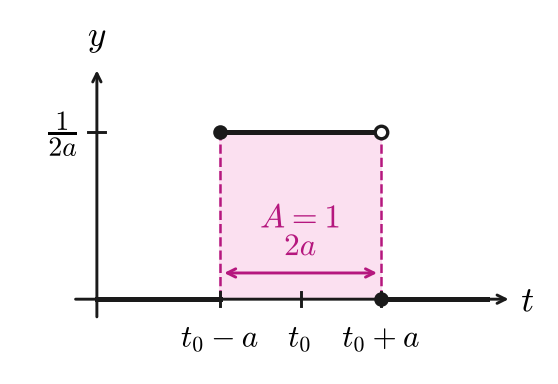
A rectangular pulse: the graph is 0, then has height for , then is 0 again. The rectangle has width and area .
Definition
The unit impulse function is defined as
If is small, this represents a large amplitude for a short time around . Note that , since the area of the rectangle is no matter what is.
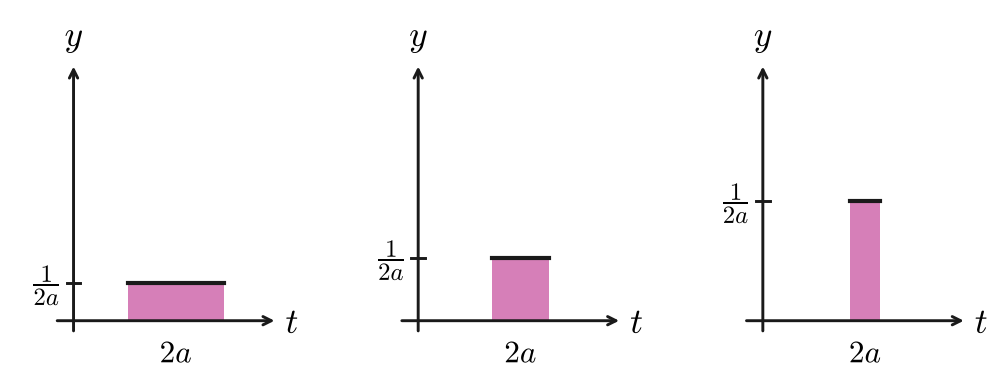
Three rectangular pulses side by side, shaded (in magenta). From left to right, the width gets smaller and the height gets larger, while the shaded area stays equal to 1.
Definition
The Dirac delta “function” is .
It possesses the properties
Theorem: Transform of the Dirac Delta Function
For , .
Proof
Recall
The transform of a unit step function is .
Write the pulse as a difference of two unit step functions, one turning on at and one at :
Transform each step function:
Now let . The limit has the form , so use L’Hôpital’s rule, differentiating with respect to :
Note that when , we have .
This is .
7.5b
Example
Use the Laplace transform to solve the given initial-value problem.
Solution
Recall
and .
Transform each term of the equation, using and :
Take the inverse transform. Each exponential shifts and turns it on at that time:
Since sine has period , .
Answer:
Solution
Transform each term; both initial values are 0:
Since ,
Two partial fraction decompositions are needed: one for the first term, and one that works for both of the last two terms.
So
Take the inverse transform. Each exponential becomes a unit step, and is replaced by or in the function it multiplies:
Answer: