8.2 Homogeneous Linear Systems: Class Notes
8.2a
Some matrix preliminaries
A matrix and a column vector:
(Square brackets, , mean the same thing.)
To multiply a matrix by a column, multiply each row of the matrix by the column, entry by entry, and add:
For example,
The order matters: is not defined here, because a row of has only one entry while a column of has two.
Identity matrix:
Multiplying by the identity changes nothing. Each row of times each column of picks out one entry of :
The zero vector is or . The matrix equation is a system of equations, and is the solution to the system.
Linear algebra result
If has a solution with , then .
A solution is called a nontrivial solution; is the trivial solution.
Augmented matrices (Gaussian elimination)
Solve the system by eliminating from equation (2):
Take (2) minus 4 times (1); the cancels:
The new system is . The augmented matrix keeps only the numbers, and the same step is the row operation :
A second system, where the right sides are all 0:
Using , the second row becomes all zeros. The determinant of the coefficient matrix is 0:
The trivial solution always works. Because the determinant is 0, the system also has nontrivial solutions (the second equation adds nothing new).
8.2b
Consider the system which, in form is
The solution is . This is a superposition of
These have the form . Here is an eigenvalue; it is the solution to an equation. is an associated eigenvector.
For example,
This has the form with : multiplying the eigenvector by just scales it by the eigenvalue.
Suppose is a solution to . Differentiate and substitute:
Divide both sides by (never zero):
This is a system of the form . We seek nontrivial solutions (), so by the linear algebra result
This is the characteristic equation. Solve it for the eigenvalues ; then, for each , solve for the eigenvector .
8.2c
Example
Find the general solution of the given system.
Solution
Set the determinant equal to 0 (product of the main diagonal minus product of the other diagonal):
So . For each eigenvalue, solve .
:
With , the rows say and , so . Take :
:
Let , so :
Answer:
8.2d
Example
Find the general solution of the given system.
Solution
Set and expand along the first row, with alternating signs +, −, +. The third entry of row 1 is 0, so only two terms remain:
Factor out the common :
So .
:
Rows 1 and 3 say and , so . Row 2 becomes , so . Let ; then :
:
Row 3 already has in front. Clear the 5 in row 2 with :
Dividing by gives the row , which matches row 3, so turns row 3 into zeros:
Solve each row for the other unknowns in terms of :
Let . Then and :
: the same steps give
Answer:
A matrix can have eigenvalues that are
- real (distinct)
- real (repeated)
- complex
8.2e
Complex eigenvalues
If is an eigenvalue, so is its complex conjugate , and
are solutions. By Euler’s formula,
By the superposition principle, these combinations are also solutions, and they are real:
Aside
The same combinations applied to pick out its real and imaginary parts:
Let and . (So is the real part of and is its imaginary part.) Then
This leads to a theorem:
Theorem
Let be an eigenvalue of and let . Then
Example
Find the general solution of the given system.
Solution
This doesn’t factor, so complete the square: move the constant over and add 25 to both sides.
: subtract along the diagonal.
Check that the determinant is 0 (so the rows are multiples of each other): . ✓ So one row is enough. Row 2 gives
Let . Then . Split into real and imaginary parts, :
Use the theorem with and :
Answer:
8.2f
Repeated eigenvalues:
Example
Find the general solution of the given system.
Solution
So is repeated (multiplicity 2).
So , or . Let :
We have only one eigenvector. In this case, we find a vector such that .
(Rationale will come later.)
Row 2: , so . Let . Then :
The general solution is , with and :
Answer:
8.2g
Example
Find the general solution of the given system.
Solution
Expanding the determinant gives the eigenvalues . For , solving gives
(repeated):
Every row is a multiple of . With two free unknowns, this repeated eigenvalue has two independent eigenvectors, so no is needed.
Let . Then :
Let . Then , so :
Answer:
Aforementioned Rationale
In the case of a repeated eigenvalue but not enough eigenvectors (defective), we have
If is repeated three times, a third solution is
Suppose
Differentiate (product rule on the first term):
Then becomes
Divide out , distribute , and collect everything on one side, grouping the terms and the constant terms:
This must hold for every , so each group is :
The first is already true, since is an eigenvector. The second is exactly the system we solved to find .
Problem: two connected mixing tanks
As shown in the diagram, two large connected mixing tanks and initially contain 100 gallons of brine. Liquid is pumped in and out of the tanks as indicated in the figure; the mixture pumped between and out of a tank is assumed to be well-stirred. Construct a mathematical model in the form of a linear system of first-order differential equations for the number of pounds and of salt in tanks and , respectively, at time . Write the system in matrix form.
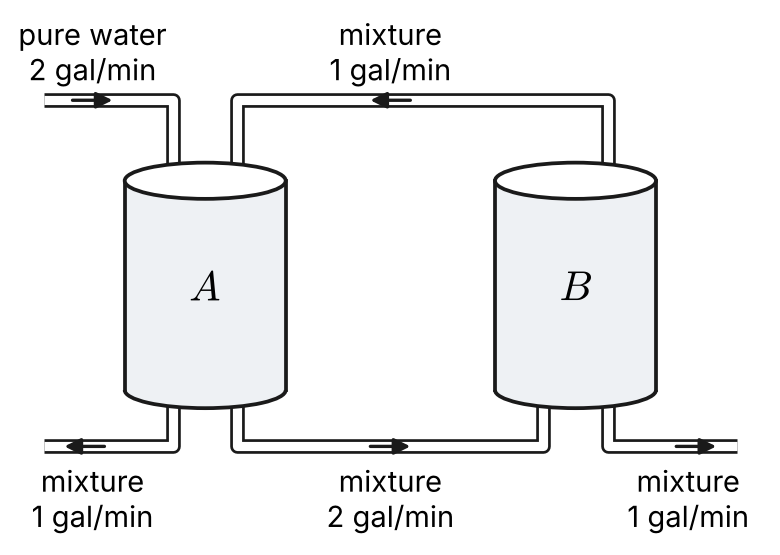
Two connected tanks, on the left and on the right. Pure water flows into tank at 2 gal/min. Mixture is pumped from tank to tank at 2 gal/min, and from tank back to tank at 1 gal/min. Mixture drains out of tank at 1 gal/min and out of tank at 1 gal/min.
Where this model is used
AI response to where this model is used: This type of coupled mixing tank model shows up in several real engineering and scientific contexts:
Environmental & Water Treatment The most direct application is wastewater treatment plants, where tanks are linked in series or loops to progressively dilute or react contaminants. The exact flow-in/flow-out balance you see here models how pollutant concentrations evolve through each stage.
Pharmacokinetics (Drug Modeling) This is probably the most important real use. The human body is modeled as a series of “compartments” — blood plasma, tissue, organs — and a drug moves between them at known rates. The math is identical to these tank equations. Pharmacologists use this to predict:
- How long a drug stays in your system
- When blood concentration peaks
- Proper dosing intervals
Chemical Reactors In industrial chemistry, continuous stirred-tank reactors (CSTRs) are literally this setup. Reactants flow in, products flow out, and intermediate products recirculate between vessels. Petroleum refining and pharmaceutical manufacturing use multi-tank CSTR networks constantly.
Groundwater Contamination Aquifers are modeled as interconnected “cells” exchanging water at known rates. When a contaminant spills, hydrologists use these equations to predict how the plume spreads between underground zones over time.
HVAC and Atmospheric Modeling The atmosphere itself is divided into compartments (troposphere, boundary layer, urban airshed) with pollutants like CO2 or smog transferring between them — same mathematical structure.
The reason this model is so powerful is that any system where a substance moves between well-mixed reservoirs at proportional rates reduces to the same form of coupled linear ODEs. The tanks are just the most intuitive way to introduce the concept.